Oft-heard responses start around, “Nothing, man” and end up approaching misty-eyed ramblings about picking fruit or cooking. Certainly there’s magic and mystery lurking in those improvisatory hills…
Here’s a little diagram to help explain what I think goes on in YOUR HEAD when you’re improvising: The centre-line represents time passing. The dot in the middle represents now. To the left is the past; to the right the future.
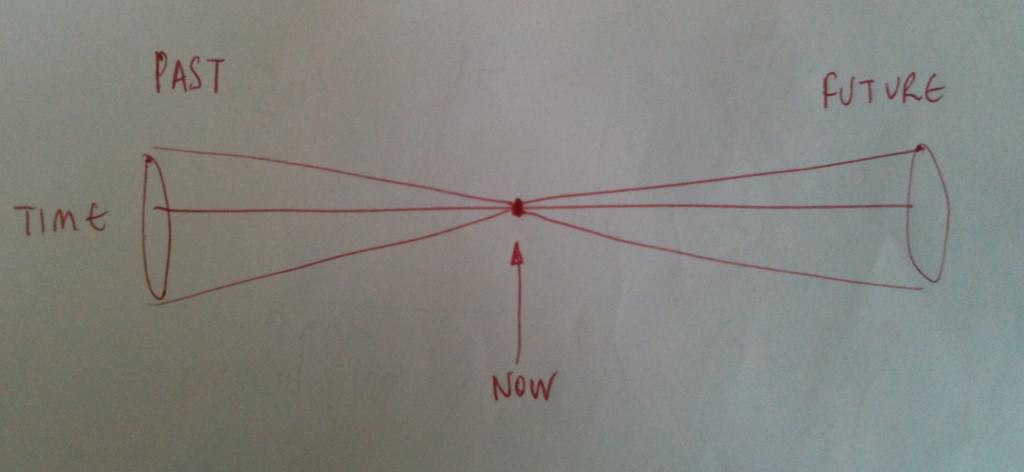
In any given moment we have an ever-decreasing awareness of the past and the future. I’m more aware of what happened three seconds ago and less aware of what happened three minutes ago. Likewise, I’m more aware of what might happen in three seconds and less aware of what might happen in three minutes. Awareness gets fuzzier the further away in time you go, in either direction, from the present moment.
You can’t be thinking of ‘nothing’ when you’re playing. If you’re unaware of what just happened, then what you played ‘now’ would have no meaning, no development, because it would always be a new thing. If you’re unaware of where you’re going, then what you just played would have no direction; you wouldn’t feel resolution points, phrase endings and so on.

Where it all goes wrong is when you get seduced by the past or the future: things like, “that was rubbish”, “that was amazing”, “I loved that feel”, “so and so is in the audience”, “I’m going to mess this up”, “somebody is filming this, what if it gets on YouTube”, etc. If you find yourself thinking thoughts along these lines then you’re not really in the present.
So ideally you want to always be in the present and just playing.
Hi There! Welcome to Nirvana!
Trouble is, it’s the stuff of magic.
Maybe what’s involved is knowing your stuff cold, or maybe being totally ignorant, or maybe it’s just not giving a flying fuck about anything, maybe it’s just loving what you do. Maybe it’s just giving up holding on to thoughts (!) and just getting on with doing whatever it is you do because it’s just more fun if you do that. Being judgmental or anxious is tiring.
Check out this video of Ronnie O’Sullivan making a maximum 147 break in an incredible 5 minutes 20 seconds.
Obviously I’ve got no idea what was going on in Ronnie O’Sullivan’s mind at the time he did this. But I’d suspect there was not a lot of mental chatter about the previous game or the last black, just a lot of doing. But who knows? it could be that while he did this there was a constant internal battle to stay present, and maybe that’s what makes a Ronnie O’Sullivan?
I’d be interested to hear if anyone has any experience in areas where you have to be ‘always on’: Air-Traffic Controller? A Surfer? A Comedian? A High-Wire Walker? A job or an activity where there’s not much room for mind-wandering or coasting. I think those people would have some interesting things to say about focus and being in the present moment. And how to get better at being there.
What do you think? Have you gotten better at this? Do you meditate? How does that affect your focus? When you’re in the moment, can you can mess about with it? Do you do an activity where you can more easily be in the present? Anyone studied Situational Awareness? Feel free to chime in with any thoughts on the matter…
Thanks for this post Mike. I hope this comment thread gets busy with musicians posting what they think of while playing.
I’m a bassist and the majority of my improvising is done with other musicians. Most of the time I’m listening hard to what the others are doing in a kind of wide to narrow sweep a bit like a pilot scanning their instruments perhaps. I’m looking for emerging themes to support, develop myself or create a counter theme to. Depending on how strong the group is at developing ideas I might be looking for a chance to introduce a metric modulation or a key/mode change too.
Playing solo, I try to think about melodies and counter-melodies rather than harmonic structures. I think that’s partly because I can process the melodic stuff in a way that gives me more flexibility. If I’m thinking of playing through, B D7 G Bb9 Eb, I’m going to handcuff myself but thinking in terms of melodies seems to give me a good combination of being held and having freedom.
The one thing I’m definitely trying not to think of are want my fingers are up to. I try to practice so I don’t have to. Sometimes it even works.
Interesting post, Mike.
My suspicion is that it’s thoughts, any thoughts, which makes the difference.
Try this…
Do some wiggling and stretching to loosen your body. Next, sit or lay in a comfortable position. Then, do your whatever you do to calm down before meditation.
Now, with everything calm, pay attention to the sensations in your body and relax parts which feel tense. The aim is to relax your body as much as possible.
Next, still aware, think a thought, any thought. Pay attention to your body and try notice any tension which arises. Relax again, clear your mind.
Do the same, this time with an unpleasant thought. Again, pay attention to see whether any tension arises.
Repeat again with a pleasant thought.
My observation while doing this exercise indicates that ANY thought creates physical tension. I suspect, though I haven’t tested it yet, is that this tension interferes with being in the zone.
I notice this while playing. I just know when it’s tight and grooving and connecting to that mysterious place/being/thing where good music comes from. I also notice the moment the connection breaks up.
Backtracking mentally has shown me that I wasn’t immersed in the song and was thinking about something or someone the moment before I dropped out.
The hard thing is to get back in the zone when I drop out because then the Ego and Superego really starts kicking in with embarrassment and other such monsters.
I suspect the ability to remain fully immersed in the music is a mysterious combination of complete mental focus and no physical tension at the same time. Something like a possession of old.
Don’t ask me whether and how you can cultivate and improve this ability. It seems likely. I know I surely need to keep working at it for now. ;-)
Fascinating subject. Remember to slip me the secret when you find it! ;-)
All the best,
Marius
Mike!
Excellent Post! An interesting exercise could be to get up early (before your mind has gotten to busy with all the stuff it gets busy with during the day), and go for a walk. During that walk, try sensing the weight of your body on your feet and see what happens to your mind. Sense your body.
Also, try experimenting with your attention by focusing on something far away (like a lamp-post or sumtin) vs the tip of your nose or or the physical inside of your head, and just observe what happens. Can be quite interesting…
Thanks for your comments, Ruben :)
I think the start of what you say above, for me, relates more to what you do with the material once you start with an idea, and I think of that kind of stuff as having a home in the practice room and I try to leave it there. Whether I succeed or not is a different matter :)
When improvising I try not to impose anything. I find when I do that, I always disrupt the flow of ideas, get in my own way. I’ve gone through phases of wanting to sound like other players; even playing their solos on gigs, or wanting to use certain devices, whatever. But I found that harder than just letting it happen.
Again, that’s my idealisation of it. I do still hear stuff I really like and want to do it on gigs. But I think I always know when the stuff I’m playing comes from just letting it happen or whether it’s stuff I already know the outcome of.
The melodic focus you mention reminds me of how Ornette Coleman and Charlie Haden talk about how they improvise. The melody dictates where you go. I like that :)
And, you’re dead right, there’s no music in mechanics.
Thanks for your thoughts.
I went through a stage a while ago where i’d read all the “inner game” books and the mystical “effortless mastery”. On reflection they are completely correct (as are you) about that level of awareness. It exists, but it’s difficult to achieve if not initiated completely at random.
My mental performance is still fairly random but what is most important it seems is to have a good warm-up and not have too much of a physical wall between playing and listening or projecting. This may be a bit of a deviation from the point but i think it’s important to mention. I’ve had some awful gigs this year where things just didn’t come together – even after intense days/weeks practice (i felt, still, in practice mode not performance mode). One way I’ve learned to hack my brain slightly (and i forget to do this a lot) is close my eyes and imagine the scene as if I AM John Scofield or Guthrie Govan and that works quite well. I also move slightly differently and become more aware of my posture and generally get deeper into the playing scenario. I suppose it’s complete play acting – but the more i’m into it – the better i seem to play. Keeping completely cool and being self conscious is not at all productive in my experience. The moment i stop pulling funny faces it all goes wrong. While I’m still discovering ways to play/think and very much underdeveloped as a musician, that’s my experience.
all the posts above were made while i had the browser was on this page so i hadn’t read them before posting :s — so sorry if I’m just rambling and reiterating previous posts.
Great post Mike, I see it as trying to let the mind relax enough to let all the stuff you have worked on flow out.. whilst being mentally agile enough to cope with/respond to what the other musicians are playing so I guess you have to be thinking of nothing and everything at the same time!
Im not a great expert at meditation but i believe the key is not to try to force the mind not to wonder, but to know how to gently steer it back on course when it does!
Thanks for those suggestions, Johan. Will try that. Why did you do it? Was it to increase your awareness of your body or your thoughts, or both?
Not sure it’s so difficult, Jake. Maybe it’s harder, or different, in music because it’s more abstact. Possibly. But say you’re surfing (I’m not in any way a surfer!) and once you’re up on the wave there’s little margin for error, you have to just ride with it, go with the flow. So maybe because it’s more tangible you can get into the right kind of focus to perform well. That’s what I was getting at with asking for examples from other jobs/activities where nailing the focus is much more important or tangible, perhaps, than playing music.
I have done that idea of imagining a scene or adopting a character, and it works best for me the more away from guitars and music I can get. ‘Play like a mushroom’ opens more possibilities than ‘play like John Scofield’. There’s no mental baggage with a mushroom. You know where you are :)
And the faces. Gotta have a bit of gurning. You are a guitarist, after all!
Marius, thanks for your ideas. I’m listening to a talk by Pema Chodron at the moment where she talks about accepting, embracing and working with those situations where you experience pain, but it could equally be applied to ‘getting out of the zone’. It the difference between when you make a mistake and start the mental turmoil, or making the same mistake and, as Ben Zander puts it, saying ‘Ah, how interesting’. Tricking yourself into somehow being still with a thought and, like you say, have no physical tension (add psychic tension too) to allow the thought to pass along. Like being silently usherd out of a party, unnoticed by anyone. (sorry that sounds like total gibberish!)
Thanks!
Thanks, Ben. Yeah, those other people mess it up :) I’m seeing more of a reason to play solo now. Not because it seems easier from this perspective; far from it! But because it offers a more direct way to practise this kind of mental training. I’ve always been petrified of playing solo, but this discussion has opened up a reason to try it more.
Have you done much meditation?
what a great post mike. With the right band and the right conditions I guess it IS a kind of Nirvana you reach, some kind of zen-like state where you don’t really ‘think’ as much as just act..hmmm, hard to word, but yeah I can really relate to your idea of ‘past, future and presence’, SO true – and that’s part of the true beauty of playing music – that when you’re truly into it, you really are living in the NOW – lit’s like meditation, healing and emotional connection/release all in one. Nice!
I dabble in zazen. That is the meditation on zen. The way I find best to becalmed myself is to breathe and feel that breath physically. The state I try,if try is the right word, to get to is a calm focussed alertness. Not a drowsy place,not a quiet place,not an empty place but an aware place. Not reacting too things but observing enjoying. The Koan ( zen parable) which helps understand this is the one about a monk chased off the edge of a cliff by a tiger and who manages to grab onto a cherry tree that happens to be sprouting on the cliff side. With the Tiger above the drop bellow and the tree roots pulling slowly away from the cliffside the monk spots a cherry. Plucks it and eats it saying ” how delicious”
That cherry could be a musical idea,the tiger & drop threats to our focus or negative thoughts awaiting us. The nowness of the moment can only occur when the value of it is being fully understood.
Not sure if that makes any sense or helps but hey jazz is the winner!
I need the zen parable about typing in the moment! Sorry for the typos.
wise words, Mike. Great post. I have to add – i rarely play live in a jazz improv context and more often in a soul funk covers band where when i do get to solo – it’s highly stylized. I love the “think like a mushroom” thing though!
I think, regrettably, I’m just not a performer. It takes a special kind. This type of dialogue needs to go on far more often though and remind us about the often neglected side of performance.
This is a very interesting subject. What you are thinking about when you are playing music has so many variables. Context is everything. What are the boundaries (if any) of the music you are engaged with? Have you had enough sleep? Are the players any good? Have you had enough to eat? Are you drunk? Etc. Etc. I could go on!
This question also neatly highlights the massive differences between practice and performance. The two are different beasts and in my experience one never bears any similarity to the other. And rightly so. If one practices on stage you can almost feel the audience and the supporting players loose interest. I know because I’m guilty as charged!
I don’t really have an answer because the focus changes all the time. On the other hand, maybe focus is all you need. Or at least a large part of it!
Nah, it just takes the right bar :)
Play on!
Jacob, thanks for chiming in!
You reminded me, I used to bo OBSESSED with Bruce Lee, and in one of his books there’s this bit where someone’s asking him about thinking and not-thinking or something like that. Anyway, he hurls a wallet at this chap and the chap catches it. It was his way of saying, ‘did you think?’ No he didn’t, he just reacted, he didn’t think about what stance he was going to get into before he caught the wallet.
I hear you about that feeling of being in the moment. Lucky we can even experience it really!
Simon, that’s a great story! Hadn’t heard that one before. It’s all about Zazen at the moment. All the authors I’m reading right now were 60s hippies, studying Zen. But aside from a Bruce Lee obsession I don’t practise. Thinking I’d really like to try meditation though. Have you heard Pema Chodron speak? She’s really good. Clear and no mysticism; makes all that stuff real and alive. Makes me want to delve deeper.
Thanks for commenting, Dan.
Yep, you’re right, it does have many variables but you’ve always got your mind. Addled, or not. So, there’s always the potential to be present in all situations. Do you reckon?
And I agree, practice and performance should be different. Maybe there’s a right brain/left brain link between the practice room and the gig.
I don’t really have an answer either, I’m just fascinated by how people do what they do, and love talking about it. So I’m really grateful for your thoughts. M
Hi Mike,
Long time no see. Hope all’s well with you :-)
I try and practise the ‘mindfulness of breathing’ or ‘metta bhavna’ meditations everyday. I’m trying to live more in the moment throughout my life, without prejudice from or judgement of the baggage I create from the past or future. Hopefully having that attitude in my daily life will cross over into my creativity.
Hope to see you soon…
Hey Stuart, yep, long time!
Thanks for putting that so succinctly.
Be great to do some music-making with you sometime :) M
Reminds me of when I was studying Husserl’s ‘The Phenomenology of Internal Time-Consciousness’ – retention, protention n’all that. You might be interested if you’ve not come across.
http://www.amazon.com/Phenomenology-Internal-Time-Consciousness-Husserl/dp/0253200970
http://plato.stanford.edu/entries/husserl/#LocEpoPerNoeHylTimCon
Ade
Great topic. I agree with Dan about practice and performance. During practice sessions I’m much more analytical and self-critical, but when performing I try to be in the moment, and not judge myself, although that still happens except in rare moments of inspiration.
I used to rock climb to quite a good standard and when leading a difficult pitch no concious thoughts would enter my mind, just total focus and concentration, close to what Buddhists call Samadhi, which is usually attained through meditation. On those rare occasions when it’s all going as it should and flowing on stage, I experience a similar feeling.
There also seems to be a difference in my mind when performing music from memory and improvisation. Playing classical pieces I tend to be more aware of dynamics, phrasing and articulation and when improvising I’m more absorbed in melody and harmony. I find it harder to be in the moment when playing pieces with which I’m very familiar. Does anyone else experience that?
Mindfulness, as Stuart mentions, is the state of mind I strive for when playing; trying to quiet the internal chatter that can be so intrusive.
I like this quote from Aaron Copeland about the creative process:
“Inspiration may be a form of superconciousness, or perhaps subconciousness – I would’t know. But I am sure that it is the antithesis of self-conciousness”
re; areas where you have to be ‘always on’ – I think in improvising and also other kinds of prolonged concentration, there is a kind of ‘zone’ where the participant is simultaneously ‘on’ and ‘off’ and the music seems to flow. Obviously this is great when it happens collectively between two or more musicians..
I think this state of instinctive flowing concentration is more commonplace than we might think – for example when driving or operating other ‘instruments’ (computer etc) and when playing sports.
There’s sometimes a tendency to view this as ‘conscious vs unconscious’ but I think that there are in fact different levels of awareness of what’s going on, and sometimes if I’m playing sport or music really well I’ll have little awareness of exactly what I’m doing. Sometimes hearing recordings of myself can be a really pleasant surprise! Only sometimes though… :-)
Nice, Ade! Haven’t come across that. It looks like a bit of light reading ;) Cheers!
Hi Mike,
Thanks for this, very interesting insights coming together here… I hope this isn’t too obvious, but this is what I think right now, hopefully I will do sober too!
I love the fact that that you link to Ronnie’s video… I feel that it says a lot about professionalism; taking risks; the importance of practice; freedom from inner judgement (leading to self-confidence); chance…
I imagine that most pro Snooker players have had quite a few max breaks in the comfort of their own home / club, and probably there’s a reasonable amount of predictability and a method of achieving this goal.
In the video it’s all seemingly pretty much under control, flowing despite the pressure of playing in this pressurised, public situation! Then there’s a moment at 1min25 where Ronnie takes a calculated risk – and to me that’s the pivotal moment in the whole sequence. It could have all gone wrong there since so much is ultimately left to chance, how the balls fall at that point. It’s by no means a given that he’ll do so well, but he makes all the right choices, doesn’t trap himself and he takes the prize. If he’d ummmed and ahhhhed about it too much it might well have fallen apart,
So yes, there’s a lot of doing. It’s calculated, well rehearsed, self assured, well executed and lucky to some extent (but not flukey!). It’s a good analogy for improvisation in general…
For me, trying to play music well requires me to be aware of all these elements. I don’t want to drink/drug too much in case it affects my physical coordination or mental acuity. If I do, I’m never satisfied that I’ve played as well I could have. But anyway, that’s a side-issue in many ways…
Knowing the music, understanding its rhythmic shape and mentally hearing the harmonic structure of it – these are most important aspects of music I can think of. I try my best to avoid clichés or riffs and to just play through inspiration, but I think this requires a total connection with the fretboard and with advanced harmonic ideas – something I’m still working hard on… So, sometimes I can close my eyes, imagine the line and just play it… but often I’m staring intently at a chart, trying to scan ahead to see what chord is coming up and then hopefully make a good connection somehow and not make too many clams…
Sadly, sometimes I’m thinking about shopping or what I’m doing the next day or some other distracted thought, and then it all tends to go to shit.
John McLaughlin once said that Tony Williams taught him to breathe with the pulse of the music… He also has said that improvisation is like a beautiful exotic bird; on occasions, if it chooses to, it may sit on your shoulder and in that case it’s the most liberating and beautiful thing in the world…
cheers,
Mark
Great post. Here are some on thinking and playing that may be relevant.
When people talk about the process of learning, we often talk about 4 stages in the process for the learner:
1. Unconscious incompetence (“I think I sound great when I’m singing in the shower – I should audition for X Factor”)
2. Conscious incompetence (“When I saw the audition on TV, I realised how bad I really was”)
3. Conscious competence (“The high note comes next, I need to remember what my teacher said and leave time to take a deep breath”
4. Unconscious competence (“I don’t even have to think about it but it seems to work”)
Interestingly, people with newly acquired skills at stage 3 often make the best teachers because they can articulate exactly how it’s done. People at stage are likely to be “Masters” who say – “just watch/listen to me and see what you can learn”. It’s not that they’re not think it’s just that the thinking is at a deeper more impulsive, less conscious level – a “natural” desire to make things beautiful, logical, focused, complementary to the other musicians interesting, deeper emotional stuff. What’s in their conscious mind. Well, nothing possibly!
Thanks for your comment, Paul.
Rock climbing is a great example of an activity where the focus has to be ‘on’. I guess the challenge is, having known the feeling of total focus and concentration, to bring it to every part of your life – the mindfulness part.
When things are challenging, it seems to me that the mind has more potential for focus; and, when things are not as challenging, the mind may, more easily, wander. I guess that’s what makes meditation on things like breathing, where you ‘know’ what’s going to happen, such a great practice.
Hi, Ben. Thanks for your comment.
I agree with you about having different ‘awarenesses’. We all know from experience that it’s possible to deepen awareness of things by practice; and that other people have a different awareness of, say, music or a conversation, from their perspective.
But there’s also this ability to not get ‘hooked’ by one’s awareness of one’s awareness :) That seems, to me, to be the key to riding the wave of improvisation.
Think we’re probably talking about the same thing. And I feel like I’m gibbering a bit now. So, as I’m aware I’m talking nonesense, I’ll stop before I become so aware that I delete this response :)
Mike,
I wrote a long reply to this post then deleted it.
Kevin
Very interesting. Re ; air traffic controllers, I met one once. What I can tell you is theyonly work 30 mins at a time and will not consider you if you are a smoker/ more than moderate drinker and definitely no divorcees! For that you are paid £35,000 just when you are training; never found out how much when fully qualified.
I do recall one gig with Salford college Big band- I had a 16 bar solo at the end of one piece changing key each bar,and I shut my eyes and went for it. Without sounding pretentious I was “gone” and about three quarters the way though woke up and thought “shit, where am I?” looked up at Robin who was conducting and he was fixed on me and bringing me down. This was broadcast on Tv so I have a record of what I did but all I can say is I was I the moment and paying attention to bog all else! One of my better solos I think:-)
Thanks for your comment, Paul.
30 mins makes sense. Guess that has implications for how long to do tasks that require concentration, such as practicing, learning tunes, etc.
Thanks!
Mike
Experiments that have been done on the brain and our decision making capacity, seem to suggest that there is a delay of roughly a second between when our subconscious mind makes a decision and when we become aware of making the decision consciously. Aside from what this says about our wider ability to actually exercise “free will”, it presents some interesting questions regarding the nature of improvisation. The below speech has some insights:
http://www.ted.com/talks/charles_limb_your_brain_on_improv.html
Personally I believe the evidence points to the fact that “consciousness” (self consciousness) definitely gets in the way of music making but also that we all need to be continually refreshing and adding to our reservoir of ideas by actively listening to music. I think it’s so easy to forget to just listen, particularly now we can all carry our entire music collection around in our pockets, or instantly access countless versions of tunes on the net. I think one of the most satisfying ways to practice mindfulness is to put headphones on, close your eyes and really listen to well recorded improvised music, hear the interplay between the musicians, move the focus of concentration from one instrument to another and hear the natural reverberation in the studio. In this way I believe when I’m playing my own responses will be more natural and unconscious.
Hopefully.
Hey Stuart,
Really enjoyed the TED talk, and your comments. Fascinating!
And you’re right, I’ve been neglecting that kind of deep listening of late, tending to go into my own thoughts for ideas. Thanks for reminding me to listen!
I sort of see the ‘watering of my mind’ [ha!] as: getting ideas/models from ‘out there’, and pulling ideas from my imagination.
Thanks again, I really could spend ALL day just thinking about this sort of stuff :)
@ Kevin, I wish I’d done that.
In performance, for me – when it flows, playing is playing, there is no thinking, just attention and presence.
Practice is of course completely different…
Hi everyone,
I am a Psychology student currently working on a study for my dissertation that might be of interest to the people here. The study will explore whether the practice of mindfulness meditation can increase the perceived musical creativity of a group of musicians. I will interview participants about their creative process and then introduce them to a month-long meditation course. Afterwards I will interview the participants again to see if they perceive any change in their creativity. If anyone has any suggestions for interview questions I could ask participants regarding creativity or would like to share with me any experiences of musical creativity that were particular meditative I’d love to hear from you :)
Hi Mike
Hope your well
This was a post from a while a go but it’s something that fascinates us all,
You might have already heard of if but there is a great book out by a psychologist names Dr Steve Peters called the chimp paradox,
He is working with Ronnie O sullivan at present,
It’s s phenominal read and is really helping me as a performing musician
It’s basically about how our inner chimp can hijack us in certain situations, and try’s to help us think logically not too emotionally,
It’s changed my life and I guarantee there are plenty of other books out there that talk about the same subject with a different spin, but this is working for me, it may not be for everyone but it’s something worth checking out
The chimp paradox
Dr Steve Peters
Hope your well Mike
Take care
Danny
Hey Danny,
Thanks for your comment :) I’ve read that book. I like it. Similar to that, but with PICTURES! is this 2-part post on procrastination that I really like.
Part 1. http://www.waitbutwhy.com/2013/10/why-procrastinators-procrastinate.html
Part 2. http://waitbutwhy.com/2013/11/how-to-beat-procrastination.html
Funny how things come together like this!
I think the Wait but Why post made me look at, say, Isaiah Berlin’s idea of higher and lower self, The Inner Game of Music’s self1 and self2, left-brain/right-brain, resistance, lizard brain, etc, etc, aLL that stuff! as being connected. But anyway, picturing that tendency as a Chimp makes the idea clearer
Ta.
I play the best music when I think of my girl. Sad or happy, the music flows freest then. It’s really hard to improvise while putting inhibitions on oneself; I play the piano in my high school’s library and if I try to keep quiet to not disturb people the music sucks. Also, having no emotional or musical inspiration results in a bad run.
Hi Mike,
I just stumbled upon this post a few clicks after watching Charles Limb’s TED Talk. Love those happy coincidences… After reading most of this thread, I’m glad to see it picking up again.
Like you, I have always been interested in the improvisational process. I think that once you’ve experienced that flow that happens when the music seems to play itself while you silently witness it, you’re hooked and will continue to search for it.
I agree with the comments above about the difference between practice and performance except this. I believe you have to also practice improvising. I like to treat this process much like any other muscle group. It must be used, stretched and strengthened in order to be quick and dependable. I spend much of my practice time improvising, but limiting parameters in different ways depending what I’m seeking to strengthen. I might limit rhythm so that I can focus more on harmony, or limit the range in order to learn to play more relevantly within. I like to push patterns or shapes through a chord progression in an improvised way. I also love to improvise warm-ups and devise improvised exercises that will improve what has just been identified in improvisation.
Meditation has been brought up above. As a long term Transcendental Meditation practitioner I can vow for the positive effects of meditation. Years ago we had a house gig at a nicer restaurant downtown. I would meditate right before going to the gig so that I could enjoy that clear state of mind while playing. Many times the solos came effortlessly. I would love to have the time to do it that way now!
One last thing. I don’t really thing about anyone before playing. But I did have an experience in which it really worked. In that house gig twenty some years ago, my primary role was as a vocalist. Since those days I don’t really sing much. I was on a gig with my group singing the rubato beginning to Wives and Lovers. Then I had a mental block and couldn’t remember the next lyric as the last chord hung in the air. I was starting to worry how I was going to get out of this, when I saw my two year old daughter in front of me at the lip of the stage. She was beaming with Cheetos all around her mouth and on her little hands. I found myself reaching down to scoop her up. As we smiled at each other, the lyric came out of my mouth and my body started to relax. Years later I understand what happened. According to the Heart-math Institute, the heart has between 60% – 80% neurons and is therefore a thinking organ. They believe the heart is the newest emerging brain. In other words, when you feel calm and relaxed you’re thinking with the smartest brain you have. I don’t know enough about whether their science pans out or not. I do know that when I’m relaxed and feeling good, I play a lot better. So in that way, thinking of someone you love could put you into a better state to play.
I hope this helps. Thoughts?…
Hi Greg,
Thanks so much for taking the time to write! Really appreciate your thoughts.
I’m a big fan of the approach you mention. [limiting parameters]
I see it as feeding yourself stuff to use. One way is internal, the other external. External means anything you hear, listening, transcribing, etc; internal means exercising your imagination, forcing yourself to come up with new stuff, and so on. That’s my little mental model for now :)
I had a similar experience when I was announcing a song once and my daughter stood up and shouted, ‘Daddy is a Durr-brain’ :)
I need to try out what you wrote.
Also, I checked out your music, and you sound Great! Thanks again for stopping by.
M
Our band has made it a habit to begin every rehearsal with a free improvisation time, which is a nice way to practice all of the above. No rules, time signatures, key centres,etc. No judgement of the self or others, no ‘wrong’ notes.
The hope is to still create a thing that could be enjoyably heard, by employing all the other aspects of musicality, such as really listening and connecting with each other and with some kind of zone, having the confidance NOT to play, bringing the thing to some kind of coherent conclusion etc.
Not playing, I think, is an oft overlooked skill, and helps keep the ego/superego reigned in a bit.